3. Immigration - A Tool for Vested Interests
May 18 2026
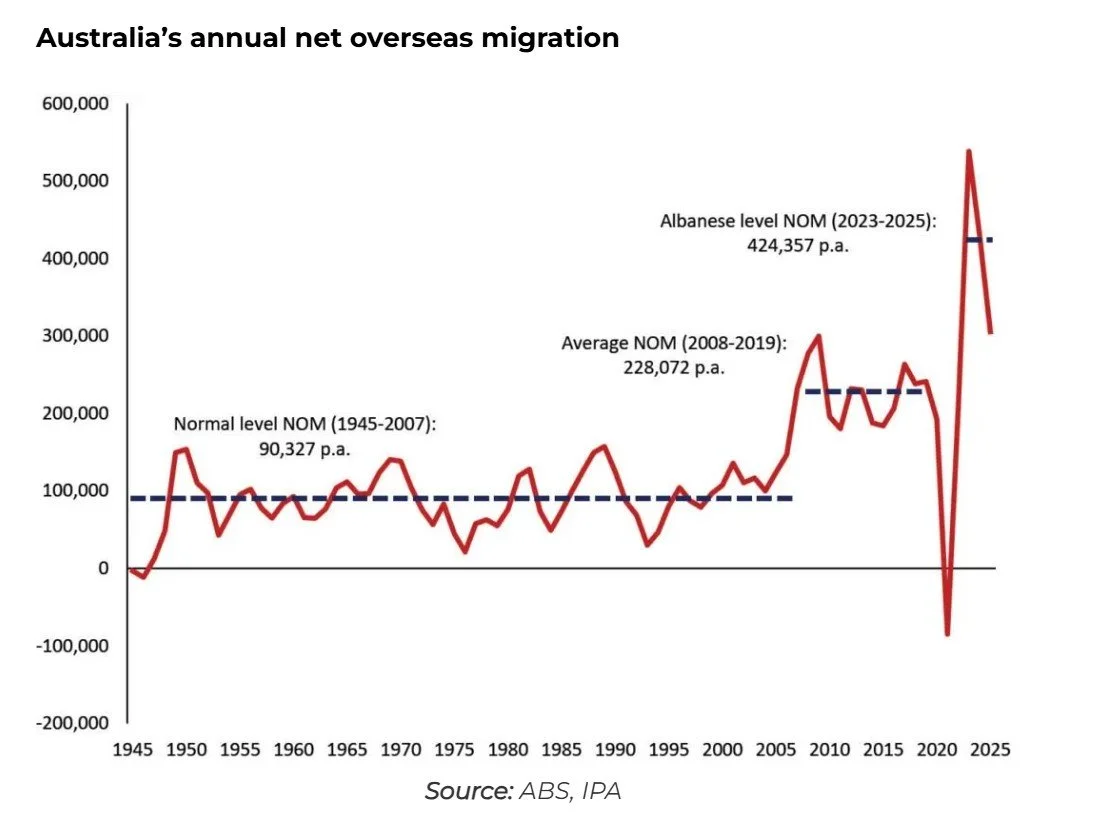
Annual intake more than doubled from 2005 and 1.3m have arrived in the last 3 years - a 5% population increase from immigration alone.
Australia has an institutional accountability problem, and the growing dysfunction of the immigration system is one of its clearest symptoms.
Through much of the 1980s and 1990s, Australia’s annual net overseas migration generally sat between roughly 50,000 and 120,000 people per year, with population growth more evenly split between migration and natural increase. Since the mid-2000s, however, Australia has gradually normalised a permanently high-migration growth model, with annual intake frequently exceeding 200,000 people and peaking above 500,000 post-COVID. The country of origin has significantly shifted from Europe and the Anglosphere to Asia and the Middle East.
At the same time, Australia’s overseas-born population has roughly doubled since 2000, rising from around 4.3 million people (roughly 23% of the population) to almost 9 million today (around 32%).
The issue is not simply the scale itself. Australia has historically integrated immigrants remarkably well. The issue is that housing, infrastructure, enforcement capability, and civic integration systems were never redesigned for a country operating permanently at these intake levels.
Social cohesion is not automatic. It depends on functioning institutions, broadly shared economic opportunity, enforceable rules, and a general belief that the system is fair.
Those conditions are weakening.
The debate is often framed (particularly by those with a vested interest in the status quo) as though Australians must choose between being ‘pro-immigration’ or ‘anti-immigration’ or more starkly, ‘inclusive’ or ‘racist’. This is a deflection from the more important question which is whether the system remains fit for purpose.
For vested interests, it certainly has been. For Australian’s in general, it is not, and increasingly so.
The immigration system now serves too many competing interests unrelated to the long-term interests of the country itself:
universities dependent on international student revenue,
corporations seeking cheaper and more flexible labour,
property markets dependent on population growth,
governments dependent on headline GDP growth,
Immigrant groups themselves, who have foreign and domestic policy objectives not necessarily aligned with Australian interests
and bureaucratic systems that expand alongside higher demand for government services
The education sector is one of the clearest examples.
Australian universities have gradually evolved from educational institutions into migration-linked export businesses heavily dependent on international student revenue. As a result, student visas increasingly stop functioning purely as educational pathways and begin functioning as de facto migration pathways.
One of the more extraordinary features of Australia’s international education system is that universities were permitted to massively expand international enrolments without any corresponding obligation to provide accommodation capacity at similar scale. The universities captured the revenue while hundreds of thousands of additional students were pushed directly into already constrained private rental markets. Nor are universities compelled to transport, provide medical care, or provide any other infrastructure for their revenue base.
Recent estimates suggest there are between 80,000 and 100,000 unlawful non-citizens currently residing in Australia, many having originally entered through lawful visa pathways including the education sector. In addition, separate investigations and government reporting have repeatedly identified large-scale visa fraud, sham enrolments, fabricated work histories, false relationship claims, and inaccurate declarations used to gain entry or remain in the country.
Government and labour market data increasingly confirm that the international education system functions as a long-term migration pipeline rather than a temporary export industry. Jobs and Skills Australia estimates that roughly 35–40% of international students from the early 2010s ultimately obtained permanent residency, while ABS data shows the most common pathway is student visa to graduate visa → skilled or permanent migration over a period of several years. Many others remain in Australia through repeated study enrolments, bridging visas, partner visas, or other forms of “visa hopping,” a practice the Department of Home Affairs has recently moved to curtail. In practical terms, large numbers of temporary entrants become long-term residents, adding ongoing demand for housing, transport, infrastructure, and public services.
The issue that government and education institutions publicly frame international education as a temporary export industry while structurally relying on it as a permanent population-growth mechanism.
None of this is occurring in secret, and ordinary Australians can see the difference between reality and the rhetoric.
Universities know foreign students are highly profitable. Migration agents know there is enormous money to be made exploiting loopholes and grey areas. Governments know rapid migration boosts headline GDP, supports housing demand, and masks structural economic weakness.
The purpose of skilled migration is supposed to be strengthening the country: filling genuine capability gaps, importing scarce expertise, and improving long-term economic performance.
Increasingly, however, the system functions as a source of cheap labour, population growth, revenue for certain industries and property demand.
Those are not the same thing and negative externalities are increasingly pushed to society at large. The negative externalities are not merely economic. They are civic.
When ordinary Australians watch laws being selectively enforced, loopholes openly exploited, and obvious abuses tolerated because powerful sectors benefit financially, confidence in institutions deteriorates.
People stop believing the system is fair. They stop believing rules matter. They stop believing the country is capable of solving large problems even where the solutions are obvious. They lose pride in their community, and their country. Cynicism abounds, and social trust, once lost, is extremely difficult to rebuild.
Housing affordability deteriorates. Infrastructure lags. Congestion worsens. Public services become strained. Younger Australians increasingly struggle to access the standard of living their parents considered normal. But the deeper problem is the growing perception that nobody in authority is willing to seriously address the issue because the political and economic incentives all point the other way.
This deterioration in trust is measurable. The Australian Election Study found trust in federal government fell from around 86% in the late 2000s to roughly 40% in recent years, while broader satisfaction with democracy has also declined sharply. More recent polling from Edelman and the Grattan Institute shows Australia now sitting in “distrust territory,” with only around one-third of Australians expressing trust in the federal government. Social cohesion ultimately depends less on slogans about diversity and more on whether people believe institutions are competent, fair, and acting in the interests of the country rather than the interests attached to the system itself.
And any attempt to rebalance the system is aggressively reframed as xenophobia, racism, or “far-right politics,” even where the underlying concerns are administrative, economic, or civic in nature.
This is not accidental.
Once institutions become financially and politically dependent on a system, they naturally begin defending the system itself. Criticism becomes morally delegitimised because genuine reform threatens entrenched interests.
As with other forms of institutional drift, the system increasingly exists to preserve itself.
Importantly, none of this means immigration itself is inherently destabilising. Australia historically integrated successive immigrant waves remarkably well because several conditions broadly held:
housing remained relatively accessible,
infrastructure broadly expanded alongside growth,
labour markets remained comparatively strong,
laws and expectations were enforced more consistently,
and newcomers entered a society confident in its own institutions and identity.
Those conditions are weakening. Social cohesion depends on reciprocal obligations from both sides. Immigrants must integrate into the legal, civic, and cultural framework of the country they join. The host society must operate institutions capable of managing migration competently, enforcing laws consistently, and maintaining broadly shared economic opportunity.
Neither side can fully compensate when the institutional layer fails. Long-term public trust depends less on whether immigration exists and more on whether people believe the system is competently managed, fairly enforced, and aligned with the interests of the country as a whole.
Once people begin believing institutions primarily serve themselves and the economic ecosystems attached to them, trust deteriorates rapidly.
That is the real risk Australia faces.
