4. Failure is Rewarded in Western Bureaucracies
3rd July 2026
In Australia, the NDIS, Indigenous affairs administration, naval procurement, corporate tax minimisation, and the sprawling compliance and advisory ecosystems surrounding both government and large corporations are all systems that appear increasingly optimised for continuity and expansion despite mounting evidence of dysfunction.
In fact, the bureaucracies morph from being structured to solve problems, to perpetuating themselves regardless of outcomes.
The result is a society where process increasingly substitutes for outcomes, complexity substitutes for accountability, and institutional preservation is prioritised over public purpose.
1. Legitimate problems create institutional mandates
Most of these systems begin with legitimate objectives. Disability support, Indigenous disadvantage, national defence, workplace safety, corporate governance, environmental protection, and economic development are all real problems requiring large scale interventions.
2. Mandates create administrative ecosystems
Once governments commit sufficient funding or regulatory authority, ecosystems rapidly form around implementation. Administrative and commercial layers emerge to interpret, manage, monitor, legitimise, and expand the system.
At this stage the institution is no longer merely solving a problem. It is creating an economy around the management of the problem. Over time, the original beneficiary is no longer the only stakeholder. The system begins supporting a broader network of institutional, political, and economic interests whose interests depend on the system’s continuation.
This is the key transition. The system stops being only a delivery mechanism and becomes a constituency.
The NDIS illustrates this clearly. What began as a targeted support programme evolved into a vast administrative and commercial ecosystem with their own political gravity and economic inertia.
4. Responsibility diffuses
As systems grow, responsibility becomes dispersed across governments, regulators, contractors, consultants, and so on. Failure rarely belongs clearly to any single actor.
This is one reason large institutional failures often persist for years without meaningful consequence. Failure becomes difficult to clearly attribute and therefore difficult to punish. Pointing out failure is in nobody’s interest, as it threatens the programme.
Naval defence procurement is good example. By the time major delays and enormous cost overruns become undeniable, cancellation itself threatens jobs, sunk costs, political relationships, and the legitimacy of the procurement process itself. Continuation becomes politically easier than correction. Hence the Hunter class frigates now cost $10bn each, whereas the Japanese will sell us Mogami class ships for $1bn each. Hunter is a more capable design, but it is not 10x the capability of the Mogami.
5. Metrics replace outcomes
As accountability diffuses, institutions increasingly substitute process for outcomes as the primary measure of legitimacy. Governance frameworks, reporting structures, compliance systems, consultation processes, and procedural oversight become evidence of institutional integrity even where substantive outcomes stagnate or deteriorate. Human resources and legal process dominates.
6. Failure creates demand for more system
Once adherence to metrics become more important than programme outcomes, the blame for failure must shift from the bureaucracy (which is hitting every metric). Instead, it is evidence that the problem is larger than previously understood, therefore justifying more administration, funding and bureaucracy.
In effect, the system metabolises failure into growth.
7. Narrative shielding develops
Any criticism threatens the surrounding ecosystem itself. As a result, narrative protection mechanisms emerge which raise the reputational and political cost of scrutiny.
On the progressive side: Criticism can be framed as racism, discrimination, misogyny, or some other form of intolerance, accusations designed to raise the social cost of criticism so high as to silence it.
Conservatives: ideas like sovereign risk, anti-business sentiment and socialism proliferate, and are designed to achieve the same goals.
Entire sectors eventually begin operating with assumptions treated less as politically contestable ideas requiring empirical evidence and more as foundational orthodoxies beyond discussion.
Some progressive sacred cows:
· Diversity is a strength
· Higher migration levels are economically and socially necessary
· Trans women are women
· Persistent structural discrimination against women requires ongoing institutional intervention
Conservative versions:
· Increasing resource taxation creates sovereign risk
· Housing prices must not materially decline
· GDP growth is a sufficient proxy for national wellbeing
· Markets allocate resources more efficiently than governments in most cases
When universities, NGOs, public-sector departments, advisory bodies, the media, corporate HR reinforce the same frameworks internally, criticism carries reputational or professional risk whether the criticism is factually correct or not.
8. Reform is avoided
The deeper problem is not merely waste, or even corruption. It is that over time these become increasingly tolerated side-effects of institutional preservation. Narrative shielding goes into overdrive, creating cultural divides in society and corroding trust in institutions.
In the US, Minnesota’s “Feeding Our Future” scandal involved roughly US$250 million in fraudulent claims against a federal child nutrition programme. Dozens of individuals were charged, 80-90% of which were from Minnesota’s Somali-American community. Subsequent investigations found that fears of racism accusations reduced regulators’ willingness to intervene despite clear evidence of fraud. Governor Tim Walz, whose constituency was being investigated, publicly described evidence of fraud as racist during the controversy, demonstrating how reputational protection can begin competing with institutional accountability itself.
The Rudd Government’s proposed mining tax in 2010 triggered an aggressive campaign from the resource sector, which framed higher taxation as a threat to jobs, investment, and national prosperity. Within weeks, Rudd was removed, the tax was heavily watered down under Julia Gillard, and later repealed entirely.
Its deeper legacy was institutional. The episode helped entrench “sovereign risk” and “investment flight” as political orthodoxies in Australia, dramatically raising the political cost of challenging entrenched resource interests. The narrative itself became part of the system’s protective architecture.
As systems mature, scrutiny increasingly occurs only under overwhelming public pressure, media exposure, fiscal crisis, or political embarrassment. Even then, reform is usually calibrated to restore legitimacy rather than fundamentally simplify or contract the system.
The upside can be very low unemployment. The cost is more diffuse; poor productivity, misallocated resources, the gradual erosion of trust in institutions, inflamed culture wars and the diminishing ability of the productive middle to pay for it all.
3. Immigration - A Tool for Vested Interests
May 18 2026
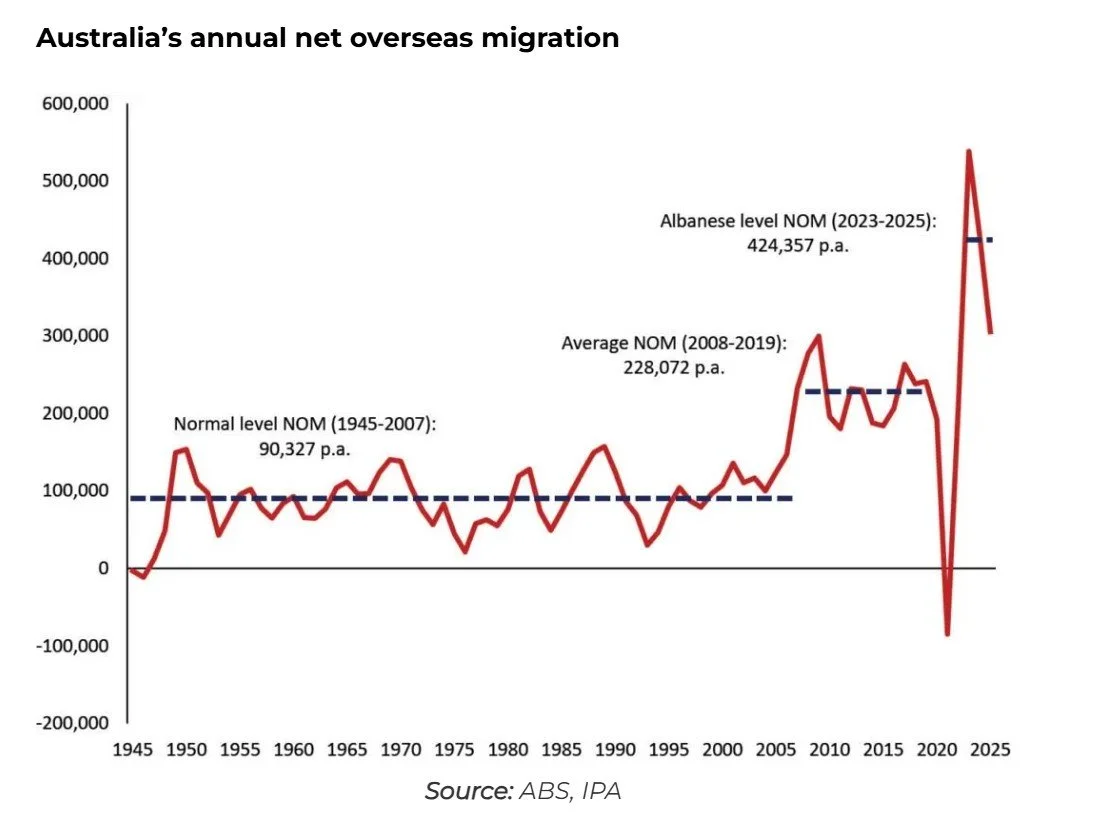
Annual intake more than doubled from 2005 and 1.3m have arrived in the last 3 years - a 5% population increase from immigration alone.
Australia has an institutional accountability problem, and the growing dysfunction of the immigration system is one of its clearest symptoms.
Through much of the 1980s and 1990s, Australia’s annual net overseas migration generally sat between roughly 50,000 and 120,000 people per year, with population growth more evenly split between migration and natural increase. Since the mid-2000s, however, Australia has gradually normalised a permanently high-migration growth model, with annual intake frequently exceeding 200,000 people and peaking above 500,000 post-COVID. The country of origin has significantly shifted from Europe and the Anglosphere to Asia and the Middle East.
At the same time, Australia’s overseas-born population has roughly doubled since 2000, rising from around 4.3 million people (roughly 23% of the population) to almost 9 million today (around 32%).
The issue is not simply the scale itself. Australia has historically integrated immigrants remarkably well. The issue is that housing, infrastructure, enforcement capability, and civic integration systems were never redesigned for a country operating permanently at these intake levels.
Social cohesion is not automatic. It depends on functioning institutions, broadly shared economic opportunity, enforceable rules, and a general belief that the system is fair.
Those conditions are weakening.
The debate is often framed (particularly by those with a vested interest in the status quo) as though Australians must choose between being ‘pro-immigration’ or ‘anti-immigration’ or more starkly, ‘inclusive’ or ‘racist’. This is a deflection from the more important question which is whether the system remains fit for purpose.
For vested interests, it certainly has been. For Australian’s in general, it is not, and increasingly so.
The immigration system now serves too many competing interests unrelated to the long-term interests of the country itself:
universities dependent on international student revenue,
corporations seeking cheaper and more flexible labour,
property markets dependent on population growth,
governments dependent on headline GDP growth,
Immigrant groups themselves, who have foreign and domestic policy objectives not necessarily aligned with Australian interests
and bureaucratic systems that expand alongside higher demand for government services
The education sector is one of the clearest examples.
Australian universities have gradually evolved from educational institutions into migration-linked export businesses heavily dependent on international student revenue. As a result, student visas increasingly stop functioning purely as educational pathways and begin functioning as de facto migration pathways.
One of the more extraordinary features of Australia’s international education system is that universities were permitted to massively expand international enrolments without any corresponding obligation to provide accommodation capacity at similar scale. The universities captured the revenue while hundreds of thousands of additional students were pushed directly into already constrained private rental markets. Nor are universities compelled to transport, provide medical care, or provide any other infrastructure for their revenue base.
Recent estimates suggest there are between 80,000 and 100,000 unlawful non-citizens currently residing in Australia, many having originally entered through lawful visa pathways including the education sector. In addition, separate investigations and government reporting have repeatedly identified large-scale visa fraud, sham enrolments, fabricated work histories, false relationship claims, and inaccurate declarations used to gain entry or remain in the country.
Government and labour market data increasingly confirm that the international education system functions as a long-term migration pipeline rather than a temporary export industry. Jobs and Skills Australia estimates that roughly 35–40% of international students from the early 2010s ultimately obtained permanent residency, while ABS data shows the most common pathway is student visa to graduate visa → skilled or permanent migration over a period of several years. Many others remain in Australia through repeated study enrolments, bridging visas, partner visas, or other forms of “visa hopping,” a practice the Department of Home Affairs has recently moved to curtail. In practical terms, large numbers of temporary entrants become long-term residents, adding ongoing demand for housing, transport, infrastructure, and public services.
The issue that government and education institutions publicly frame international education as a temporary export industry while structurally relying on it as a permanent population-growth mechanism.
None of this is occurring in secret, and ordinary Australians can see the difference between reality and the rhetoric.
Universities know foreign students are highly profitable. Migration agents know there is enormous money to be made exploiting loopholes and grey areas. Governments know rapid migration boosts headline GDP, supports housing demand, and masks structural economic weakness.
The purpose of skilled migration is supposed to be strengthening the country: filling genuine capability gaps, importing scarce expertise, and improving long-term economic performance.
Increasingly, however, the system functions as a source of cheap labour, population growth, revenue for certain industries and property demand.
Those are not the same thing and negative externalities are increasingly pushed to society at large. The negative externalities are not merely economic. They are civic.
When ordinary Australians watch laws being selectively enforced, loopholes openly exploited, and obvious abuses tolerated because powerful sectors benefit financially, confidence in institutions deteriorates.
People stop believing the system is fair. They stop believing rules matter. They stop believing the country is capable of solving large problems even where the solutions are obvious. They lose pride in their community, and their country. Cynicism abounds, and social trust, once lost, is extremely difficult to rebuild.
Housing affordability deteriorates. Infrastructure lags. Congestion worsens. Public services become strained. Younger Australians increasingly struggle to access the standard of living their parents considered normal. But the deeper problem is the growing perception that nobody in authority is willing to seriously address the issue because the political and economic incentives all point the other way.
This deterioration in trust is measurable. The Australian Election Study found trust in federal government fell from around 86% in the late 2000s to roughly 40% in recent years, while broader satisfaction with democracy has also declined sharply. More recent polling from Edelman and the Grattan Institute shows Australia now sitting in “distrust territory,” with only around one-third of Australians expressing trust in the federal government. Social cohesion ultimately depends less on slogans about diversity and more on whether people believe institutions are competent, fair, and acting in the interests of the country rather than the interests attached to the system itself.
And any attempt to rebalance the system is aggressively reframed as xenophobia, racism, or “far-right politics,” even where the underlying concerns are administrative, economic, or civic in nature.
This is not accidental.
Once institutions become financially and politically dependent on a system, they naturally begin defending the system itself. Criticism becomes morally delegitimised because genuine reform threatens entrenched interests.
As with other forms of institutional drift, the system increasingly exists to preserve itself.
Importantly, none of this means immigration itself is inherently destabilising. Australia historically integrated successive immigrant waves remarkably well because several conditions broadly held:
housing remained relatively accessible,
infrastructure broadly expanded alongside growth,
labour markets remained comparatively strong,
laws and expectations were enforced more consistently,
and newcomers entered a society confident in its own institutions and identity.
Those conditions are weakening. Social cohesion depends on reciprocal obligations from both sides. Immigrants must integrate into the legal, civic, and cultural framework of the country they join. The host society must operate institutions capable of managing migration competently, enforcing laws consistently, and maintaining broadly shared economic opportunity.
Neither side can fully compensate when the institutional layer fails. Long-term public trust depends less on whether immigration exists and more on whether people believe the system is competently managed, fairly enforced, and aligned with the interests of the country as a whole.
Once people begin believing institutions primarily serve themselves and the economic ecosystems attached to them, trust deteriorates rapidly.
That is the real risk Australia faces.
2. The Irreversible Bloat of Bureaucracy
6th May 2026
Imagine an economy where nobody ever gets fired; the unemployment rate is always low; GDP always goes up. How wonderful – and even better – we’re living in it.
And it’s a disaster.
The ABC recently reported that over 8 million Australians now rely on some form of government income, up from 6m a decade ago, with mental health increasingly a route to benefits. The NDIS is growing at a fantastic 25% a year.
Australia’s institutional drift isn’t best understood as incompetence or corruption in the traditional sense. Institutions are drifting because they are structurally incentivised to do so.
As systems scale, the incentives that govern them change. What begins as outcome-driven problem solving gradually becomes process-driven system management.
After WW2, the state was smaller with a clearer mandate. Success was measured by outcomes e.g. infrastructure built, problems solved. Department heads were usually drawn from engineering, military, or domain expertise. They were technocrats.
The state was a means to an end.
Now, the state is much larger and more complex. Success is measured by procedural integrity, stakeholder management, and risk management. Paths to leadership are dominated by policy, advisory, or administrative careers. Failure is diffuse, hard to define, and rarely terminal. The government is an employment bureau, as well as a service provider.
Now, the state is the end as well as the means.
Once a programme is big and complex enough, a predictable pattern emerges. As programmes expand, so do the administrative layers. Careers and industries attach themselves to the programme. Oversight and compliance explode as risk tolerance collapses. Success stops looking like ‘does it work’ and instead looks like ‘is it being administered correctly?’
At that point, the system is no longer built to solve the original problem; it is optimised to sustain itself.
For example, multiple analyses from groups including the Australian Industry Group, Commonwealth Bank and the Institute of Public Affairs estimate that roughly 70–80% of net jobs created in Australia since 2023 have been in the public sector or government-funded ‘non-market’ sectors of the economy.
Government workers rarely vote to shrink their department budgets.
Whether this is in the nation’s best interest is irrelevant; it is in the government’s best interest.
The National Disability Insurance Scheme is an obvious example. It has morphed from a targeted, high-trust social program, into a vast administrative and commercial ecosystem whose incentives are increasingly decoupled from participant outcomes.
The system is no longer judged purely on outcomes for participants, but also on employment creation, economic activity, stakeholder satisfaction, and political risk.
Politicians, even if they want to, are unable to aggressively curtail the system, even where fraud, leakage, price inflation, and waste are openly acknowledged: Serious reform threatens not just recipients, but an entire administrative and commercial ecosystem built around delivery.
This is not limited to the benefits sector. It is a feature of most sectors. For example, legal and consulting firms operate within similair incentive structures, benefitting from and reinforcing an increasingly complex system of laws they help to create. Federal/state government consultant spending has been estimated around ~$20bn+ annually. This reinforces a broader pattern:
Modern economies increasingly reward fluency in institutional navigation as much as productive output itself. Institutional complexity is an economic growth sector.
Over time, this becomes a productivity problem, because more economic activity is tied to administration, compliance, and extracting funding rather than genuinely productive output.
Failure does not trigger contraction, in fact, it triggers expansion: more laws, more funding, more administration, more complexity, to manage the problem.
Nobody ever gets fired; the unemployment rate is always low; GDP always goes up.
The corollary of course is GDP per capita – down. Prices – up. Service quality – down.
Historically, systems like this rarely reform themselves voluntarily. Meaningful contraction usually requires an external shock: recession, fiscal crisis, war, or a sharp collapse in public trust.
Absent that pressure, the path of least resistance is continuation.
Australia remains wealthy enough to sustain this dynamic for now, but capital is finite. Institutional capacity is finite. Social cohesion is finite. A system that cannot contract is not truly stable.
It is simply delaying adjustment.
1. The Respectable Corruption of Australia
EP. 06
April 30th 2026
Australia isn’t failing through dramatic collapse or overt criminality. It’s something more subtle and insidious. Australia is, in a structural sense, a corrupt system, but not in the way the term is usually understood.
This isn’t corruption driven by bribery or violence. It’s a quieter form, a kind of genteel corruption, where incentives across the system reward inaction, protectionism, and self-interest, often at the expense of the broader public.
For decades, Australia has benefited from sustained economic growth. Rising asset values, strong commodity demand, and population expansion have created a sense that trade-offs don’t really matter—that competing demands can all be accommodated without consequence.
This is false. Australia is still a constrained system, and we are testing limits.
Capital is finite. Infrastructure is finite. Institutional capacity is finite. Social cohesion is finite. When those constraints are ignored, incentives drift. Systems begin to reward behaviours that are rational for individuals or groups, but damaging at the national level. For example, rent-seeking, avoidance of accountability, and the steady expansion of institutions beyond their productive value.
Many of these institutions are not just underperforming, they are functionally broken. When a system consistently produces outcomes that are economically inefficient, socially divisive, or openly exploited at scale, it is not operating as intended.
The fact that these outcomes can be explained by incentives does not excuse them, in fact it explains why they persist. Systems don’t self-correct if the people operating within them benefit from the current structure.
Examples are not hard to find:
Large corporates spending millions in political donations to avoid billions in tax
Multi-billion dollar fraud and leakage within the NDIS with limited enforcement
Tens of billions spent annually on Indigenous programs with limited improvement in outcomes
Migration running at historically high levels without matching infrastructure, integration planning, or even a clear rationale
Housing costs reaching 10–15x income in major cities
These are not marginal issues. They are large, persistent, and well understood—and yet they remain largely unaddressed. At that point, the question is no longer whether the system is working, but who it is working for.
There is also a reinforcing feedback loop at work. As government expands, it creates the expectation that government should be responsible for solving an ever-wider range of problems. That expectation, in turn, justifies further expansion—more programs, more funding, more intervention.
Over time, fewer problems are allowed to exist outside that frame. The question stops being whether government should intervene, and becomes how much more it should do. In most policy debates, failure is framed as either poor execution or a need for greater intervention. The possibility that the system itself is overextended is rarely treated as the primary cause.
At the centre of this system is the political class. By background, it is increasingly detached from commercial and operational reality. Roughly 20–30% of MPs have never had any private sector experience at all. That rises to 50–60% with no meaningful private-sector career, and around 60–70% have no exposure to commercial accountability—no P&L responsibility, no revenue pressure, no market risk.
That matters. Because without exposure to real constraints, policy becomes an exercise in managing stakeholders rather than solving problems.
The result is a country that, despite increasing wealth, is becoming more fragmented, less productive, and less confident in its institutions. This is not unique to Australia, in fact is prevalent across the West.
This isn’t a story of sudden decline - yet. For now, it is a story of warped incentives, out of alignment with outcomes in the public interest, and a system that increasingly reinforces its own expansion regardless of performance.
It is not sustainable.